
Beginning with Instinct
Working with spontaneous memorials rarely begins with a plan. More often, it begins with a feeling; an instinctive pull to act, to protect, and to bear witness to collective responses to trauma. This article approaches spontaneous memorials through the lens of afterlives to explore how objects, emotions, and responsibilities persist beyond the initial rapid response collection phase. When such memorials are cleared from streets and squares, their meanings do not resolve or disappear; instead, they enter new institutional, emotional, and ethical states that extend both the presence and social relevance of these makeshift, public responses to tragedy (Arvanitis 2019; Arvanitis and Simpson 2024).

Written from within practice, this article reflects on what happens after spontaneous memorials are removed from public space and drawn into museum or archival contexts. It explores the gap between instinctive, care-led responses to trauma and the institutional structures tasked with managing the long-term future of such collections. Rather than offering a purely academic account, it examines spontaneous memorials as afterlives that resist closure by continuing to exist as a lingering presence that shapes curatorial decision-making, professional wellbeing, and the ethics of remembrance beyond the moment of tragedy and loss (Arvanitis and Simpson 2024).
The Context
At approximately 10.30pm on 22 May 2017, a homemade bomb was detonated in the foyer of Manchester Arena as crowds were leaving an Ariana Grande concert. This devastating attack, the deadliest in the UK since the 2005 London bombings, claimed the lives of 23 people (including the bomber) and injured more than 1,000 others.
Within hours, spontaneous memorial sites began to emerge across Manchester city centre. These makeshift public spaces became places of remembrance and mourning, where people gathered to leave gifts and tributes in honour of those who had been killed. Thousands of flowers, candles, balloons, cards and notes, soft toys, painted pebbles, and artwork were laid at these sites, each individual object adding another piece to the widespread, collective reaction to unexpected violence and loss. Over the following days, these memorials grew rapidly, both in scale and significance, dominating the city centre for almost three weeks.
On 9 June 2017, the clearance of these sites began. The task was undertaken by Manchester City Council staff, a team from Manchester Art Gallery (MAG), and staff and students from the University of Manchester. Together, they carried out the sensitive removal of all memorial objects, forming what is now known as the Manchester Together Archive (MTA).
From the outset, this was not experienced as a standard collections process. There were no established protocols for how to handle the vast number of memorial objects (over 10,000) left at various sites across the city. Decisions were made quickly and were guided by instinct rather than policy; by asking not “what is usually done?” but “what feels right, now?”
Encountering the Gap
As the work of the Manchester Together Archive developed, a pattern became increasingly clear. While museums and archives are well-versed in formal collection strategies, documentation, and long-term care, spontaneous memorial collections sit awkwardly within these frameworks, with details that often fall between the gaps. They are, instead, emotionally charged, ethically complex, and time-sensitive. They do not arrive through formal accessioning, and they resist easy categorisation.
Throughout the activities undertaken by the MTA (including restoration, volunteer recruitment, cataloguing, filmmaking, and research), a distinct gap in professional support became apparent; that this kind of work rarely aligns with existing collections management policies or institutional guidance and, as a result, leaves many of the most demanding aspects of working with these collections overlooked.

This gap is not only procedural, but emotional. Working with spontaneous memorials involves prolonged exposure to grief, trauma, and loss, which can include work with bereaved family members and survivors. Yet heritage professionals are rarely trained or supported to manage the emotional labour this entails. Thus, the afterlife of a memorial, as a transition from public expression to managed collection, becomes a site of tension between care, responsibility, and capacity.
The Afterlives of Memorial Objects
When spontaneous memorials are cleared from public space, their visibility changes, but their meaning does not disappear (Maynor 2016; Milošević 2018). Instead, these important objects transition into new afterlives. They are catalogued and stored in boxes and cabinets or transformed into digital archives; they become the focal point of exhibitions, or the subject of research; they continue to exist through conversations with families, survivors, and communities. Each transition raises new questions. Who are these objects for now? Who has the right to access them? How long should they be kept? And who is responsible for their care?
These afterlives are not linear. They are relational, shaped by ongoing social and emotional connections. Memorial objects continue to hold affective power long after their physical removal from public view. For practitioners, caring for these collections means caring not only for material things, but for the emotional traces they carry. This presents a set of challenges that are distinct from most museum or archive work:
- Emotional complexity. Memorial objects are intensely personal, imbued with grief, hope, anger, love, or unresolved trauma. Handling them requires sensitivity to the emotional states of donors, survivors, bereaved families, and colleagues.
- Ethical considerations. Questions of ownership, consent, and representation are central. Decisions about access, retention, and display are often made in the absence of formal guidance, and with an acute awareness of public scrutiny.
- Practical uncertainty. Many organisations encounter spontaneous memorials unexpectedly and must act quickly. There is rarely time to develop protocols before decisions about removal, storage, and documentation must be made.
- Emotional labour. Engaging with traumatic material over extended periods has a cumulative impact. Yet emotional labour is rarely acknowledged within institutional structures, and formal psychosocial support is often absent.
While the MTA has continued to document and critically reflect on its own processes, it has also sought to challenge the wider lack of policy, practice, and support for professionals working with spontaneous memorial collections.
Understanding the Gap: Survey and Review
To better understand this gap, we undertook a programme of research aimed at identifying how it might be addressed. This included an international survey of 65 museum and cultural professionals across 12 countries; a collaborative workshop with 25 participants held in Manchester in 2024; and a review of existing guidance developed by individuals, cultural organisations, and professional bodies.
The findings were striking. Seventy-nine per cent of survey participants reported that no plan was in place before they began working with a spontaneous memorial collection. Over half (52%) said they were emotionally affected by the work, yet only 13% had accessed any form of emotional support.
Our review of existing guidance echoed these findings too. Of 34 relevant resources identified, only seven dealt directly with spontaneous memorial collections. Similarly, while 11 resources addressed emotional labour in heritage work more broadly, just six focused specifically on psychological support or trauma-informed practice. The correlation between limited guidance and reported emotional and ethical challenges was clear.
At the same time, the data revealed something else: alongside stress and difficulty, many practitioners described the work as deeply meaningful. One participant reflected, “Emotionally I feel really good about what we did with our project in terms of helping the families of the deceased and the survivors… and the wider community.” Another described feeling “guided by the urgency to salvage not only the physical objects but also… the expression of emotions embedded in each one.”
These responses point to a paradox. The absence of formal frameworks creates vulnerability, but it also creates space for autonomy, responsiveness, and instinct-led decision-making.
Several survey participants spoke about a heightened sense of purpose that emerged precisely because the work unfolded outside established systems. One reflected that working with the memorial “provided me a measure of closure, as well as reassurance that my community is full of good, decent, resilient people.”
This sense of connection (to community, to place, to shared values) is central to understanding why spontaneous memorial work matters. Without rigid protocols to fall back on, practitioners often rely on empathy, listening, and collective judgement. Decisions are made through conversation rather than policy, through responsiveness rather than prescription, and while this can be emotionally taxing, it can also be profoundly affirming and rewarding. The pressure to “do right” by the people who created the memorial becomes a guiding force. Instinct, in this context, is not careless or unprofessional; it is attentive, ethical, and deeply human.
The PLAN-CARE-HEAL Framework
Building on our research findings, we set out to develop a framework that would not replace instinct but support it. The result is PLAN-CARE-HEAL, an online guide designed for anyone working with spontaneous memorial collections.
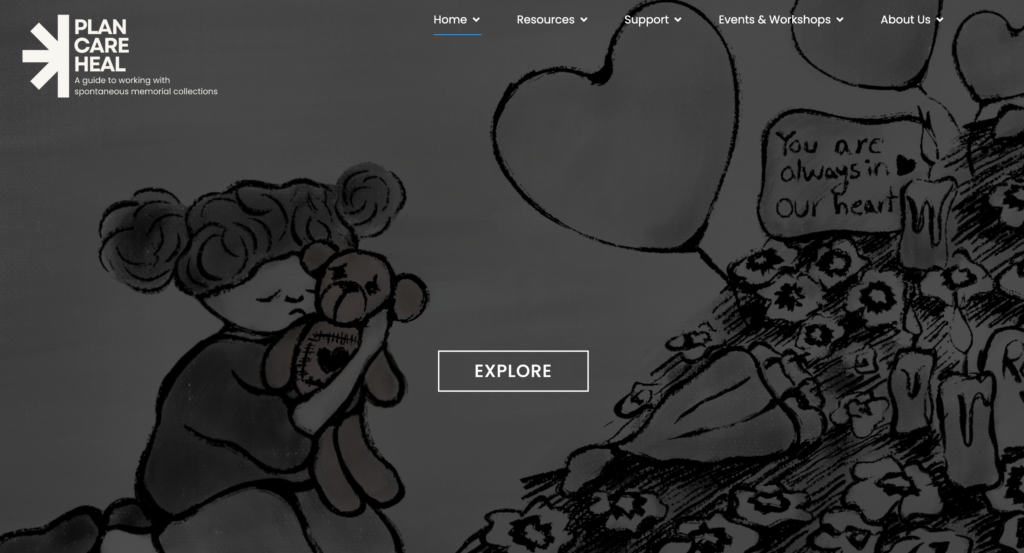
The PLAN-CARE-HEAL framework does not position itself as a one-size-fits-all solution to the challenges of working with spontaneous memorial collections but as an attempt to create an inclusive platform for people working in this space; to build confidence, encourage sharing, and promote connection and networking. It takes a longitudinal, phased approach to the afterlives of memorials, recognising that needs change over time and that no two situations are the same. Its three interrelated stages are:
- PLAN. Establishing foundations and understanding around what to expect from spontaneous memorialisation, including stakeholder engagement, ethical considerations, and preparation for emotional and logistical challenges.
- CARE. Focusing on the psychosocial support and wellbeing of practitioners and communities, alongside conservation, documentation, and decision-making around access and use.
- HEAL. Encouraging reflection, long-term sustainability, and the development of peer networks that support ongoing learning and emotional resilience.
Crucially, the framework is deliberately flexible. It does not prescribe a single way of working, but instead offers resources, case studies, and tools that practitioners can adapt to their own contexts. Capacity, circumstance, and community need are foregrounded throughout.
Rather than imposing structure, PLAN-CARE-HEAL aims to legitimise the kinds of instinctive practices that already shape this work, while providing ethical and emotional scaffolding to support them. For example, a central principle of the framework is the creation of a community of practice. Many practitioners working with spontaneous memorials report feeling isolated, unsure where to turn for advice or reassurance. By encouraging networking, sharing experiences, and peer learning, the framework seeks to counter this isolation.
By offering access to practical resources and reflective tools, PLAN-CARE-HEAL addresses the institutional and psychosocial dimensions of memorial work. It places equal value on the communities who create memorials and the professionals who care for them, recognising that both are shaped by the same emotional landscape.
As part of translating this work into an accessible and engaging format, we also explored how affective tools might support conceptual understanding of the framework. To do this, we commissioned a bespoke animation, featured on the website’s landing page. The animation visually captures the relationship between heritage professionals, spontaneous memorial sites, their objects, and the people who interact with them.
By tracing the lifecycle of a spontaneous memorial, this animation makes visible the emotional labour embedded in the memorial’s transition from public space to institutional care. Importantly, it offers an affective entry point into the framework, one that invites reflection rather than instruction. Behind every object is a network of people and experiences, and the animation serves as a reminder that responsible stewardship is as much about care as it is about process.
Conclusion: Return to Instinct
Spontaneous memorial collections occupy a complex afterlife within museums and archives. They are emotionally charged, ethically demanding, and shaped by relationships that do not end when objects are removed from public view. Our research demonstrates that the heritage sector lacks sufficient guidance, training, and psychosocial support to engage with these afterlives confidently and sustainably. In response, PLAN-CARE-HEAL offers a flexible framework that foregrounds emotional wellbeing, ethical reflection, and shared learning; not as a means of resolving uncertainty, but as a way of staying with it.
Yet it is important to return to where this work so often begins – with instinct. Even in the absence of formal collections management policies, practitioners repeatedly demonstrate a deep commitment to doing right by the people who create spontaneous memorials and by the communities they represent. The gap between feeling and framework, rather than signalling professional failure, can open space for care-led, responsive, and humane practice. In navigating the afterlives of spontaneous memorials, instinct is not something to be corrected or replaced. It is something to be recognised, supported, and sustained; a vital guide in work where objects continue to haunt, relationships remain active, and the responsibilities of care extend far beyond the moment of loss.
Written by Robert Simpson
Bibliography
Arvanitis, Kostas. 2019. “The Manchester Together Archive: Researching and Developing a Museum Practice of Spontaneous Memorials.” Museum and Society 17 (3): 510–532.
Arvanitis, Kostas, and Robert Simpson. 2024. “Making, Sharing and Extending Presence in Spontaneous Memorials: The Case of the 2017 Manchester Attack.” In Urban Terrorism in Europe (2004–19): Remembering, Imagining, and Anticipating Violence, edited by Karcher, K., Y. Dimcheva, and M. Medina. London: Palgrave Macmillan.
Maynor, Ashley. 2016. “Response to the Unthinkable: Collecting and Archiving Condolences and Temporary Memorial Materials following Public Tragedies.” In Handbook of Research on Disaster Management and Contingency Planning in Modern Libraries, edited by E. N. Decker and J. A. Townes, 582–624. Hershey, PA: Information Science Reference.
Milošević, Ana. 2018. “Can Memorials Heal Wounds?” Observing Memories: The Magazine of the European Observatory on Memories 2: 56–63.
No responses yet